Origins:
Unplugging Games, cont.
By
Justin
Hall
 SimCity
was an amibitious attempt to make a collectible card
game that wasn't combat based. It took the spirit
of a single player computer game that balanced many
variables and added peaceably cooperative competition.
With your opponents, you build a city. The roads,
rails and power lines are printed on the cards themselves
- you lay down natural resources like forests and
coastline, and then layer houses and business on top
of them to develop a full fledged city grid. Players
compete for money, generated by the card layers and
relations between adjacent cards. When you play with
groups of people, it's possible, for example, to build
a house near someone else's group of houses, which
increases the revenue you get from your house. In
this game you can get ahead without totally screwing
over your opponent. SimCity
was an amibitious attempt to make a collectible card
game that wasn't combat based. It took the spirit
of a single player computer game that balanced many
variables and added peaceably cooperative competition.
With your opponents, you build a city. The roads,
rails and power lines are printed on the cards themselves
- you lay down natural resources like forests and
coastline, and then layer houses and business on top
of them to develop a full fledged city grid. Players
compete for money, generated by the card layers and
relations between adjacent cards. When you play with
groups of people, it's possible, for example, to build
a house near someone else's group of houses, which
increases the revenue you get from your house. In
this game you can get ahead without totally screwing
over your opponent.
All that works within a framework of cooperation
- it was developed to be the type of collectible card
game that you could play with family (not having to
worry about improperly "Challenging Mom to the death!").
You lay out your resources to maximize your own point
earnings, and possibly minimize the success of your
opponents; you never directly attack your opponent.
 If
it all sounds very friendly combat, it was. Darwin
Bromley, SimCity game designer and President of Mayfair
games at the time, took a few moments away from his
train boardgaming at Origins to revisit
the SimCity experiment. He spoke lovingly of helping
fans build decks that would allow them create their
own city. Unlike Tomb Raider, which
features art almost entirely from the game system
and the computer renderings of Lara Croft, SimCity
was made at a time when such computer renderings cost
more than the resources of Mayfair games afforded.
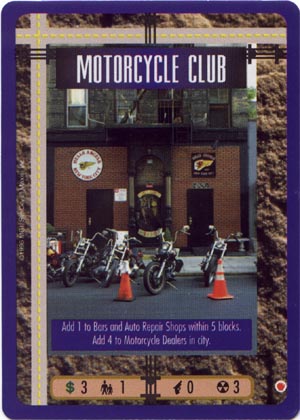
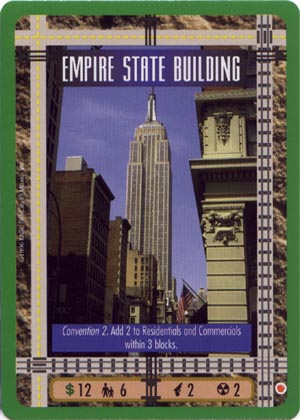
Darwin and company took photos of buildings in major
American cities themselves - you'll see the cards
in SimCity are photorealistic. The back of the SimCity
card game rule book invites players to submit pictures
of their own homes to appear as cards. If
it all sounds very friendly combat, it was. Darwin
Bromley, SimCity game designer and President of Mayfair
games at the time, took a few moments away from his
train boardgaming at Origins to revisit
the SimCity experiment. He spoke lovingly of helping
fans build decks that would allow them create their
own city. Unlike Tomb Raider, which
features art almost entirely from the game system
and the computer renderings of Lara Croft, SimCity
was made at a time when such computer renderings cost
more than the resources of Mayfair games afforded.
Darwin and company took photos of buildings in major
American cities themselves - you'll see the cards
in SimCity are photorealistic. The back of the SimCity
card game rule book invites players to submit pictures
of their own homes to appear as cards.
SimCity emerged to a hungry public in 1994, and
the initial edition sold out. Future editions were
printed heavily and they didn't sell strong. This
was shortly after Magic: The Gathering
had changed the face of hobby gaming with the trading
card game, and at the time there was a explosion in
new collectible card games. Six other collectible
card games were released the same week as SimCity.
After selling out the first run, SimCity got lost
in the shuffle. Today you can find a grande set of
game cards for
sale cheap through Mayfair games.
Still, others hurl themselves into the breach, offering
new card games based on gameplay models from card
games.
 
|

 Sign up now to review your own games and more!


 SimCity